OFDI and National Development Strategies
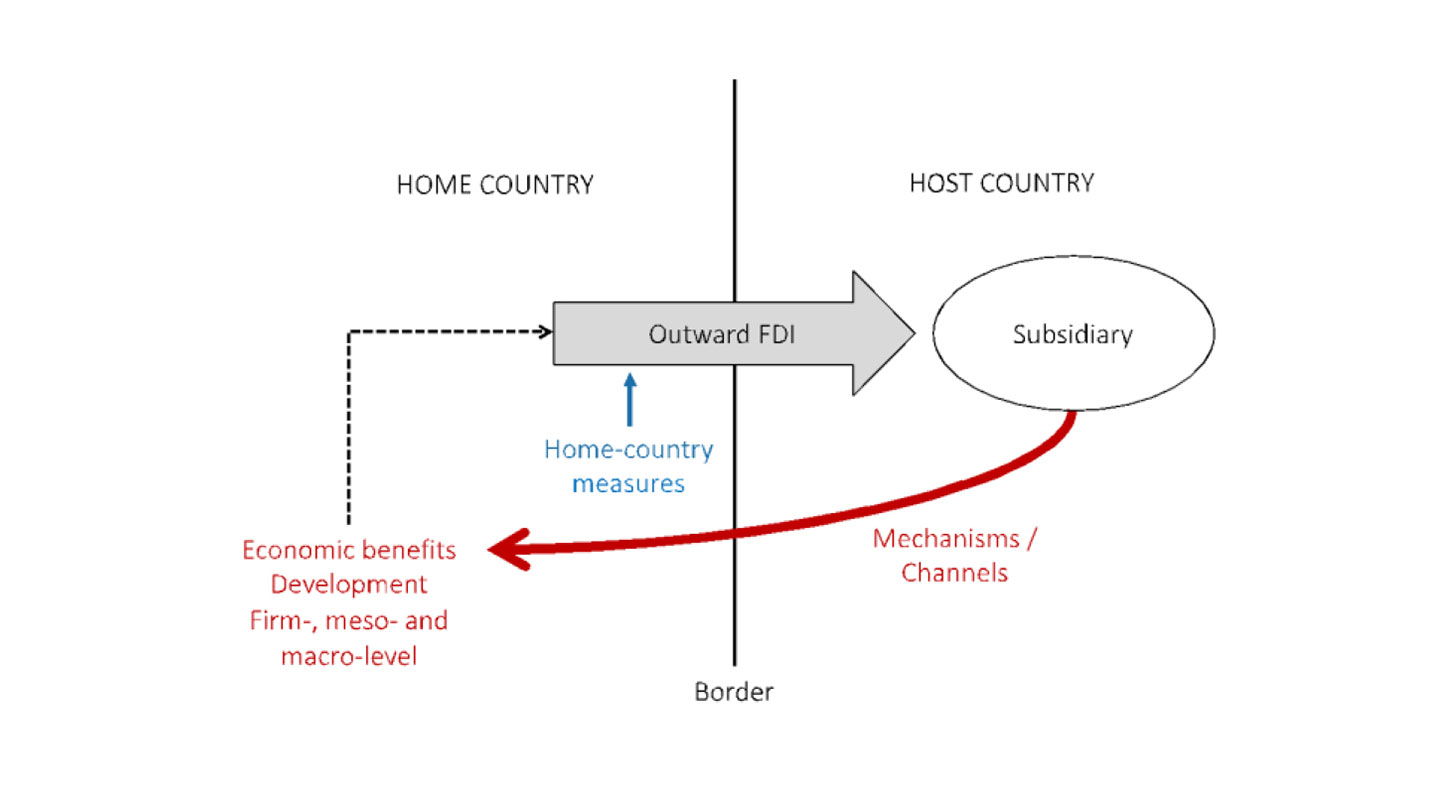
OFDI can have significant economic, social and environmental impact on the home country, i.e., the country from which the investment originates and where the investing multinational enterprise is headquartered. Figure 4 offers a basic illustration of how such home-country effects can occur.
Countries usually experience levels of OFDI that are commensurate with their own level of economic development and international competitiveness of domestic companies. Thus, good economic performance and home country development induces outward investment. Through the establishment and operation of a subsidiary in a host country, OFDI enables the multinational enterprise to pursue assets and advantages internationally. This in turn generates various kinds of financial, tangible and intangible returns. If circumstances allow, these returns can be channelled back to the home country through various mechanisms, resulting in benefits to the home country at the firm-, meso- (e.g., industry) and macro-level of the economy. These returns can potentially support the advancement of sustainable development, which can be particularly important for developing countries with growing numbers of active outward investors (Knoerich 2017, Perea and Stephenson 2018, UNESCAP 2020).
Figure 4 Home-country effects of OFDI – A basic illustration
Sources: Knoerich (2017) , UNESCAP (2020)
Recent advancements in foreign direct investment theory have highlighted the potential opportunities of OFDI, especially for multinational enterprises from developing economies. While traditional theory has focused on multinationals from developed economies and found that they exploit existing competitive advantages in overseas investments (Dunning 2001), recent theoretical advancement focusing on developing economy multinationals has confirmed their ambition to pursue assets and advantages through OFDI (Knoerich 2019). In particular, the springboard perspective describes developing economy multinationals using OFDI as a springboard to enhance their capabilities and competitiveness (Luo and Tung 2007). The linkage, leverage, learning (LLL) approach suggests that developing economy multinationals can enhance their capabilities and competitiveness by using OFDI to engage in linkage, leverage and learning overseas (Mathews 2006). Moreover, the resource-based view has been increasingly employed to examine how developing economy multinationals acquire resources overseas that they lack at home (Deng 2007, 2013). Finally, the institution-based view argues that institutions in the home country can be a source of both competitive weakness and strength for developing country multinational enterprises, which could seek to overcome the weaknesses by acquiring resources overseas through investment (Hobdari et al. 2017, Peng, Wang, and Jiang 2008, Cuervo-Cazurra and Genc 2008). To acquire overseas assets, advantages and resources, and overcome competitive weaknesses, developing country multinationals might even internationalise at comparatively early stages. The benefits reaped from overseas investments in terms of capability enhancements and improved competitiveness are often advantageous for the home economy and its sustainable development more widely (Stephenson 2018a).
However, the returns and benefits of OFDI to home economies are not guaranteed and may need to be nurtured and promoted through appropriate policies and measures (Stephenson 2021). HCMs can allow governments to create an enabling environment for OFDI. They can help maximise the benefits from OFDI and minimise any costs, and integrate OFDI into national sustainable development strategies. Accordingly, governments in developing countries are increasingly introducing HCMs to leverage OFDI and its beneficial aspects. However, HCMs can achieve varying degrees of effectiveness. Governments should thus consider the following issues when using HCMs as part of domestic economic policy:
- OFDI policy and HCMs should be incorporated into broader national development strategies, such as those laid out in national development strategy documents, Masterplans etc.
- OFDI policy and HCMs should be complementary to efforts in other areas of national and international economic policy. Complementarity with inward foreign direct investment is particularly important, but other areas, such as trade, migration, industrialisation, domestic investment and the development of small and medium-sized enterprises (SMEs), should not be neglected. It is important to achieve policy coherence across these different areas.
- OFDI policy and HCMs should reflect both the economic and sustainable development objectives of the home country government, as well as the needs and requirements of the domestic private sector.
- OFDI policy and HCMs should be chosen to promote those home-country effects that the government considers a priority (e.g., exports, economic upgrading, employment), for example to achieve specified sustainable development priorities. This prioritisation of specific home-country effects and associated OFDI activities will, in turn, influence the nature of the country’s economic and development achievements. Not all OFDI will result in the same benefits.
- OFDI policy and HCMs might need to be chosen based on a defined process through which the government identifies and decides on the economic and sustainable development objectives that OFDI should support. Such processes should involve stakeholder consultations. The resulting decisions will influence the precise choice of HCMs and how they should be targeted at companies and investment characteristics. An explicit exposition of the objectives that OFDI policy and HCMs should achieve would also facilitate future monitoring and evaluation of these policies and measures.
This Toolkit provides governments with a valuable and comprehensive resource to design and implement OFDI policy and HCMs, especially with a view to achieving sustainable development priorities. It can serve as a strong guide to governments on what types of HCMs should be employed to achieve particular economic outcomes and home-country effects, and how these HCMs should be targeted at specific companies and investment characteristics to achieve the specified sustainable development objectives. The Toolkit can also assist governments in decisions on which home-country effects should be prioritised based on their national context. In particular, the Toolkit’s inventory of empirical evidence offers information and data that can be used to assess which home-country effects are particularly promising and might be more easily nurtured through HCMs. This, in turn, can support developing country governments in their efforts to nurture OFDI so that it addresses their broader economic development ambitions and serves as a complementary channel for sustainable development.
OFDI strategies:
Some countries have laid out their OFDI strategies and associated development ambitions in specific policy documents:
Malaysia:
Third Industrial Master Plan (IMP3)
Thailand:
Announcement of the Board of Investment No. 2/2557
The Twelfth National Economic and Social Development Plan (2017-2021)